
You're choosing much more than a village
THE DOT ON THE MAP IS NOT THE PLACE
One of the easiest mistakes to make when searching for a home in France is to confuse a village with a location. You visit somewhere attractive, walk around the centre, have lunch, look at a few houses and think: yes, I could live here. Perhaps you can. But before you start searching seriously, zoom out. The village is only one dot on a much larger map. What matters is not simply what exists inside the commune boundary, but what that dot connects you to.
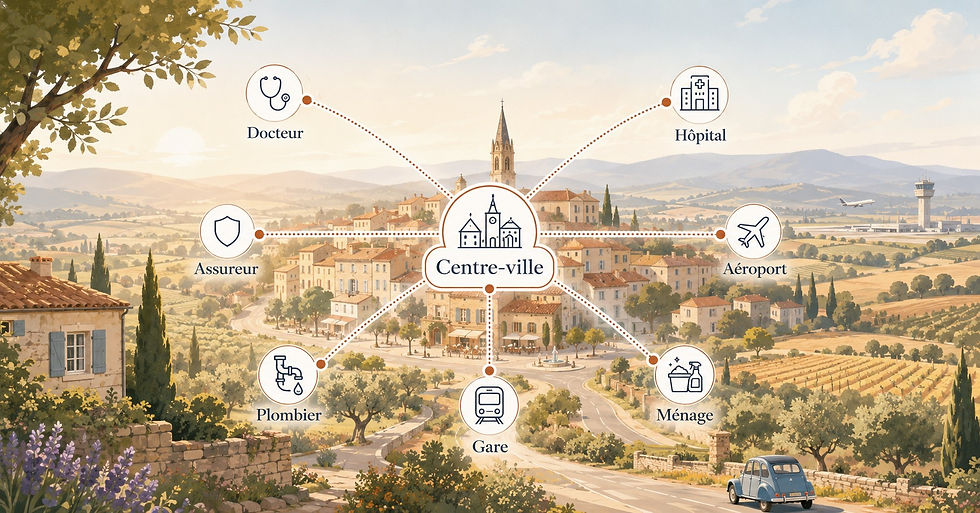
France is better understood through several maps sitting on top of one another: administrative, physical, cultural, transport — and the map of everyday life. For choosing where to live, that last one is often the most useful. Your village may have the bakery and café. The neighbouring town may provide the supermarket, doctors and restaurants. The hospital might be 35 minutes away, the TGV station 50 minutes away and the airport another half-hour beyond that. Together, they form your practical geography.
THINK IN CONSTELLATIONS
A useful way to read France is to stop thinking about isolated towns and villages and start thinking in constellations. There is often a central town providing the market, shops, healthcare, restaurants and much of the social life. Around it sit several villages, each offering a different residential experience. Beyond them may be countryside. All can belong to essentially the same ecosystem even though the addresses, property prices, architecture and atmosphere are quite different.
That changes the property search considerably. Suppose you love Uzès, Saint-Rémy-de-Provence, Gordes, Sarlat or another well-known town. There is nothing wrong with that. Famous places generally became famous for good reasons. But living ten or fifteen kilometres away might give you access to much of the same practical and social world while offering more space, fewer tourists, a different village atmosphere or a different property market. Or it might not. The point is not to avoid the famous place. It is to use it as the centre of an area worth investigating.
MAP THE LIFE, NOT JUST THE AMENITIES
This is where apparently mundane things become surprisingly important. People rarely imagine their future in France by wondering where they will buy printer cartridges or find a plumber. Yet daily life consists largely of ordinary things. Where is the supermarket you will actually use? The pharmacy? The vet? The dentist? The garage? Is there a useful weekly market? Can you buy bread without getting into the car? And when something breaks in the house, where are the people who can fix it?
The same applies more seriously to healthcare. Having a GP nearby is useful, but it is not the same as having reasonable access to a substantial hospital, emergency department or specialist services. The neighbouring town may contain doctors, dentists, physiotherapists and laboratories, while more specialised care sits much farther away. If healthcare matters to you — particularly if France is intended as a permanent retirement move — the relevant question is not merely whether there is a doctor in the village. It is how the healthcare constellation works around you.
YOUR REAL DISTANCES ARE MEASURED IN TIME
Distance on a map can also deceive. Twenty kilometres on a straight departmental road is not the same proposition as twenty kilometres through hills, villages and summer traffic. Airport access that looks perfectly reasonable online may involve an awkward route you quickly come to dislike. A railway station 40 minutes away may be extremely useful if it gives you direct trains to Paris; one 20 minutes away may matter much less if every journey requires several changes.
So map the journeys that will actually recur in your life. Think about going to the market on Saturday morning, collecting friends arriving by train, reaching the airport for an early flight, visiting the hospital, having dinner in the nearest lively town, or simply buying groceries on a wet Tuesday in February. February matters. A place with six restaurants open in August and one on a Tuesday in winter is offering two very different versions of life.
THE TOWN YOU LOVE MAY NOT BE WHERE YOU SHOULD LIVE
This is one of the more useful consequences of thinking in constellations. You may discover that the town you love should remain at the centre of your life — without becoming your address. That is not a compromise. It can be the better solution. You can use its market, restaurants, shops, cultural life and services while returning home to the quieter village, larger garden or different architecture that suits you better.
That is essentially what happened to Helen, one of the examples in the WHERE guide. She thought she wanted “the Loire Valley”, then gradually realised that what she really wanted was the Saumur ecosystem: its market, shops, restaurants, healthcare and railway connections. She did not particularly want to live in Saumur itself. A surrounding village eventually gave her the combination she wanted — peaceful and attractive, but connected to everything she actually used.
BUILD YOUR OWN MAP BEFORE YOU SEARCH FOR THE HOUSE
Once an area begins to interest you, put the property websites aside for a while. Start with the town or village and work outward. Where do people actually shop? Which market draws people from the surrounding villages? Where are the doctors and the useful hospital? Which railway station would you really use? Which airport? Where would you go for dinner, meet friends, get something repaired or spend an ordinary afternoon?
Then visit those places and drive those journeys. Return at different times. Talk to people. A map can identify the dots, but local conversations tell you what happens between them. The guide describes one buyer who used AI very effectively to identify possible villages, then discovered that conversations with shopkeepers, residents and even a pharmacist provided the local intelligence she actually needed.
Only then should the property search become dominant. The useful sequence is France → broad area → ecosystem → town or village → micro-location → property. A beautiful house can make you forgive quite a lot during a viewing. Everyday life is less forgiving.
So when you next find an appealing property in an appealing French village, do not only ask whether you like the house or even whether you like the village.
Zoom out.
What does this dot connect you to?.


Comments